
There is no overall "winner" — each format wins on a different dimension. Capsules win on precise dosing, concentration and shipping efficiency. Liquid wins on pre-treating heavy stains. Powder wins on raw cost per wash. After 12 years of manufacturing laundry capsules, here is our honest breakdown of cleaning power, real cost and environmental impact — including the trade-offs we see from inside the factory.
Side-by-Side: The Quick Comparison
| Dimension | Capsules | Liquid | Powder |
|---|---|---|---|
| Dosing accuracy | Pre-measured, zero waste | Easy to over-pour | Easy to over-pour |
| Everyday cleaning | Excellent | Excellent | Very good |
| Heavy stain pre-treat | Limited | Excellent | Moderate |
| Cost per wash | Mid-to-high | Mid | Lowest |
| Shipping efficiency | Highest (8× concentrated) | Low (70–80% water) | High |
| Packaging waste | Minimal (film + pouch) | Plastic bottles | Cardboard boxes |
| Storage sensitivity | Needs dry environment | None | Must stay dry |
Cleaning Power: It Depends on the Stain
For everyday dirt — sweat, food spills, ordinary soil — all three formats clean well when properly formulated. The differences show up at the edges.
Enzymes do the heavy lifting. Modern detergents rely on enzyme systems: proteases for protein stains, lipases for grease, amylases for starch. Liquids and capsules both carry full enzyme systems; powders traditionally struggle to keep some liquid enzymes stable, which is why premium powders increasingly turn to granulated formats.
Where capsules have a technical edge — and a limitation we're honest about. In a single-chamber liquid, certain ingredients fight each other: fabric softener actives and some bleach systems can slowly deactivate enzymes during storage. Multi-cavity capsules solve this by separating actives into chambers — cleaning power, softener, color care and perfume stay stable until they hit the water. That's why our four-cavity pods clean, soften and protect color in one dose, with a pH-neutral, phosphate-free formulation — no fluorescent brightener, no bleach agents.
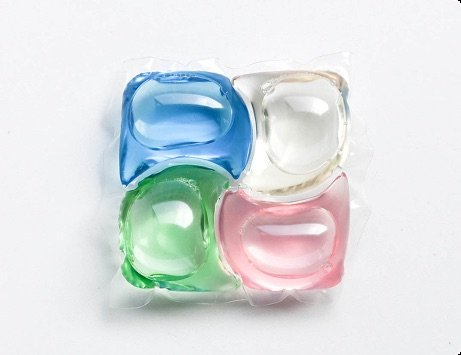
The honest limitation: for scrubbing a collar heavily stained with motor oil, nothing beats pouring liquid detergent directly onto the stain and working it in before the wash. Capsules are a complete in-wash solution, not a pre-treatment.
Cost per Wash: The Math Most Guides Skip
This is where a manufacturer's perspective really matters.
Liquid detergent is mostly water — typically 70–80%. When you ship liquid, you largely ship water. That cost is built into the price.
Capsules are concentrated. An 8× concentrated capsule carries the active ingredients of a much larger liquid dose. Our four-cavity pods run 10–15g per pac — one pod cleans a full 4–5kg load; for heavy or large loads, two pods.
A simple cost-per-wash comparison (based on typical US/EU retail prices, 2025–2026; actual prices vary by brand and market):
| Format | Typical dose per wash | Approx. cost per wash |
|---|---|---|
| Capsule | 1 pod (10–15g) | $0.15 – $0.30 |
| Liquid | 30–40 ml | $0.10 – $0.20 |
| Powder | 30–40 g | $0.05 – $0.12 |
Retail-price estimates compiled from publicly available pricing of mainstream brands; premium and private-label products fall outside these ranges.
Powder remains the cheapest per wash — that's simply true, and we manufacture capsules. But for brands, the number that matters is margin per shipping container: an 8× concentrated capsule delivers several times more washes per container than bottled liquid. For importers, that math beats the sticker price.
Environmental Impact: Facts, Not Marketing
- Capsules use water-soluble PVA film that dissolves completely during the wash — no dosing-format residue entering the water stream. Phosphate-free formulations are standard. The main criticism (plastic per dose) applies to tub packaging, which is why recyclable pouches are the mainstream direction.
- Liquid means plastic bottles — recyclable in theory, but bottles and caps remain persistent waste streams. Concentrated refill formats are improving this.
- Powder uses cardboard boxes, but historically contained phosphates (now banned in most markets) and can leave particulate residue in low-water machines.
None of the three is "the eco choice" absolutely. The trend we see from EU buyer mandates: concentrate + reduce packaging — which favors the capsule format.
Which Format Should You Choose?
For households:
- You want zero mess and precise dosing → capsules
- You regularly pre-treat tough stains → keep a liquid for spot-treating
- Budget is the top priority → powder
For retailers and brand owners choosing what to stock:
- Markets with strong eco-regulation (EU) → capsules are the growth format
- Price-driven markets → powder or large-format liquid
- Hot, humid climates → consider capsule packaging carefully; powder and liquid are more forgiving in storage and distribution
What This Means for Brands and Importers
We've exported laundry capsules to 60+ countries and launched over 200 OEM brands, and one pattern holds: format preference is regional — and it shifts.
Industry data and retail-shelf trends point the same direction:
- North America & Western Europe have the highest capsule adoption — driven by convenience habits and, in the EU, by regulation pushing concentrated formats and lighter packaging.
- Middle East & Africa remain powder-strong: price sensitivity and hot, humid distribution favor powder and liquid.
- Southeast Asia is liquid-traditional, but urban younger consumers are switching to capsules — the fastest-shifting segment to watch.
If you're deciding which format to launch in your market, the cheapest advice is wrong advice. The right question is: what does your market's retail shelf, climate, and regulation favor? That's a conversation worth having before you commit to a production run.
Frequently Asked Questions
Yes — typically 8× or higher concentration. Pods remove the water that liquid detergent ships in, delivering active ingredients only.
Quality pods are formulated to dissolve in cold water. Dissolution speed varies by film quality — one of the key differences between manufacturers.
Yes. Place the pod in the drum before loading clothes. Works in both front-load and top-load machines.